

More and more people arrive in Málaga with a clear idea.
They do not simply want to “watch Flamenco”.
They want something real.
Something that is not designed solely to fit into a tourist itinerary.
Something that does not feel like just another activity on a list.
They are looking for non-touristy Flamenco.
But… what does that really mean?
What we mean by non-touristy Flamenco
The term can seem confusing.
Because Flamenco itself is one of Spain’s most important cultural expressions, and it is natural for it to be part of the offer for those visiting the city.
The issue is not that Flamenco exists for visitors.
The issue appears when the performance adapts so much to tourism that it loses its essence.
Non-touristy Flamenco is not about who is in the audience.
It is about how the performance is created.
The signs of authentic Flamenco
When an experience is authentic, you can feel it.
You do not need to be an expert.
There are certain elements that make the difference:
- The music is performed live, without rigid structures
- There is real communication between the artists
- There is room for improvisation
- The rhythm is not forced by fixed timings
- The atmosphere allows you to feel, not just watch
Added to these elements is one key decision that completely changes the experience: the number of performances.
When a venue chooses to offer only one performance a day, it is not a matter of scheduling.
It is a way of understanding Flamenco.
All the artists’ energy, concentration and connection are poured into that single moment. There is no division, no accumulated fatigue, no automatisms.
Only presence.
And that can be felt.
In this kind of proposal, Flamenco is not adapted to fit in.
It is shown exactly as it is.
Beyond the performance: a way of feeling
Non-touristy Flamenco does not seek to impress from the outside.
It seeks to connect from within.
That is why it often takes place in smaller venues, where closeness allows details to be perceived that are lost in other formats.
The sound of the guitar without filters.
The real impact of the heel.
The silence before an intense moment.
It is not an experience designed only to be watched.
It is an experience to be lived.
What those who have experienced it say
One of the clearest ways to understand the difference is through those who have already been there.
Many people arrive with doubts… and leave with a completely different feeling.
For example, Flavio Rohner describes it like this:
“Small venue run by two musicians (guitarist and dancer). Very good music and atmosphere. Very traditional Flamenco. It is not just another tourist destination. I was very pleased with the performance and everything.”
Several important keys appear here: the intimate format, the traditional music and an experience not designed for quick consumption.
There are also those who especially highlight the closeness and intensity of the moment, as in this review written by Dorian:
“It was an incredible experience, the performance felt vibrant. The limited number of attendees made us feel part of the show. If you want to experience authentic Flamenco and not tourist traps, I recommend KELIPÉ 100%.”
Another audience member, Daphne Vila, comments:
“It was incredible! You should definitely go. At first I thought it was only a tourist show, but the professionalism of the cast was outstanding.”
This kind of perception is very common.
Many people arrive thinking it will be something “typical”… and discover something much deeper.
And in Daniela Yepes’ case, the experience goes one step further:
“This was our first live Flamenco show and we thought it was wonderful. It was an intimate place where we could feel and experience the passion and emotion transmitted by the artists. It was an unforgettable experience, especially because I was celebrating my mother’s birthday.”
Here another key element of non-touristy Flamenco appears: emotion.
It is not only what you see.
It is what you take away with you.
(Real reviews from our audience that you can see on Google My Business)
The role of the venue: why it matters so much
One of the factors that most influences the authenticity of a performance is the venue.
In proposals more oriented towards tourism, the number of attendees is usually higher.
By contrast, non-touristy Flamenco tends to favour closeness.
Not by chance.
The closer you are, the more you perceive.
And in Flamenco, nuance is everything.
The way the guitarist breathes between notes.
The intensity of the dance on the floor.
The visual connection between the artists.
All of that forms part of the experience.
Non-touristy Flamenco does not mean inaccessible
It is important to clarify something.
Looking for non-touristy Flamenco does not mean looking for something closed-off or elitist.
It means looking for something carefully crafted.
An experience where the main objective is not audience turnover, but the quality of the moment.
In fact, many of these proposals are open to anyone.
The difference lies in the intention.
Málaga: between the visible and the authentic
Málaga is a city with a very wide cultural offer.
And within that offer, Flamenco holds an important place.
This means that different types of performances coexist.
Some designed for a broad and dynamic audience.
Others focused on preserving a more authentic experience.
The challenge lies in knowing how to choose.
Not through prejudice.
But through what you truly want to experience.
KELIPÉ: non-touristy Flamenco from the roots
At KELIPÉ, we understand Flamenco as an experience that does not need to adapt in order to be valid.
That is why we work from a clear idea: to show Flamenco with its own identity.
Our format is intimate, with only one performance a day, allowing each show to be built without rush and with all the energy focused on that moment.
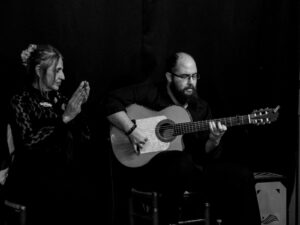
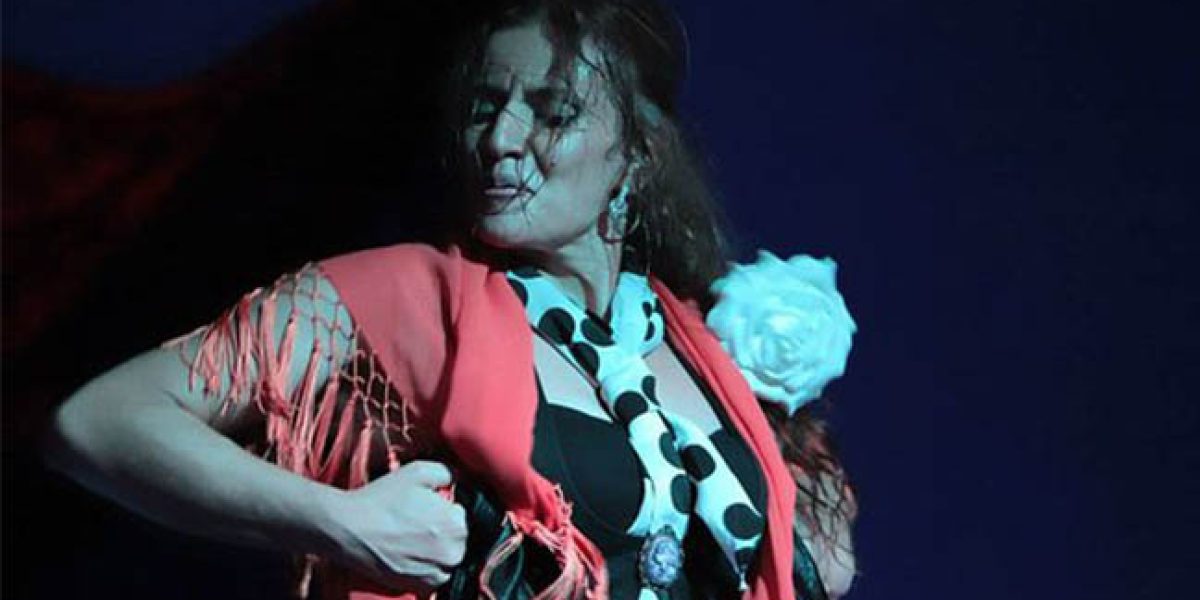
The artists —Susana La Yedra in dance and Azukita on guitar— perform original music live, maintaining a real connection on stage that does not depend on repeating a fixed structure.
Here, Flamenco is not simplified.
It is respected.
And that is what makes many people looking for non-touristy Flamenco find something different.
If you would like to experience it for yourself, you can check upcoming dates and book your ticket here.
When it stops being tourism and becomes an experience
In the end, the difference is not in the label.
It is in what happens.
You may walk in thinking you are going to watch just another show.
And leave with the feeling that you have experienced something you did not expect.
Something you do not need to analyse.
Because you have felt it.
And that is, in essence, non-touristy Flamenco.