


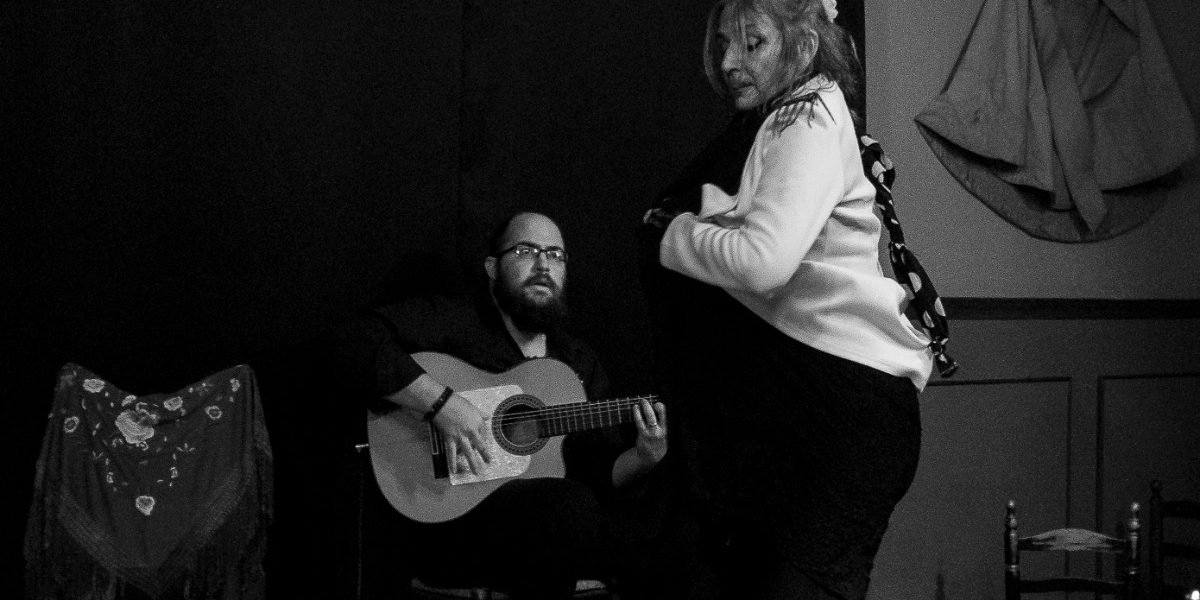
Talking about Flamenco in Malaga means talking about an important part of the city’s culture.
Malaga is a Mediterranean city with a history shaped by different cultures, a deeply rooted Andalusian identity and a cultural scene that continues to grow. Within this identity, Flamenco has a place of its own.
Flamenco singing, dance and guitar are part of Andalusia’s artistic history, as well as Malaga’s. This connection extends beyond the stage: it lives on through its artists, families, cultural spaces and the people who continue to pass this art form on to future generations.
That is why, when looking for where to experience Flamenco in Malaga, it is worth discovering the relationship between this art form and the city itself.
Flamenco is part of Malaga’s culture
Flamenco cannot be understood separately from Andalusia.
Its history is connected to different regions, families, artists and forms of expression that have passed down knowledge and ways of interpreting the art from one generation to the next.
Malaga is part of this heritage.
The city has long been, and continues to be, home to Flamenco singers, dancers and guitarists who have helped keep this tradition alive.
But talking about Flamenco in Malaga is not simply about mentioning well-known names. It is also about a way of understanding music, dance and artistic expression that remains part of the city’s cultural life.
Malaga and Its Flamenco artists
One of the best ways to understand the connection between Malaga and Flamenco is through its artists.
A tradition does not stay alive simply because it is preserved in books or archives.
It lives on because there are people who know it, perform it and continue to pass it on.
Flamenco dance, singing and guitar require years of learning and dedication. Behind a few minutes on stage lie countless hours of study, practice, rehearsal and experience.
In Malaga, this passing down of knowledge is part of the city’s artistic life.
And it is through its artists that Flamenco continues to find new forms of expression while maintaining its connection with its roots.
Flamenco dance in Malaga
Dance is probably one of the most recognisable expressions of Flamenco.
The hands, arms, body movements, turns and footwork create a language of their own.
But there is much more behind every movement than technique alone.
Flamenco dance requires a strong sense of rhythm, musical understanding and interpretative skill. The body listens to the music and responds to it.
At KELIPÉ, this approach to dance is closely connected to Susana Manzano La Yedra, founder of KELIPÉ Teatro & Centro de Arte Flamenco.
Her interpretation of Flamenco reflects both her artistic journey and a family tradition passed down through generations, which forms part of her identity as a Flamenco dancer.
Her hands do more than accompany the music.
They speak.
They carry gestures, movements and ways of feeling Flamenco that have travelled from one generation to the next, like a living memory held in the body of the dancer.
Flamenco singing and the voice of Andalusia
Flamenco singing holds another fundamental place within this art form.
The Flamenco singer’s voice conveys emotion, but also a deep understanding of the different styles, the rhythm and the relationship between singing, guitar and dance.
In Malaga, singing remains part of an artistic tradition that continues to find spaces in which to express itself.
At KELIPÉ, Antonio Cortés is the theatre’s exclusive Flamenco singer. His voice brings a connection to Malaga and Granada, alongside a family background deeply rooted in Flamenco.
His singing forms part of the dialogue between voice, guitar and dance that unfolds during each performance.
Because in Flamenco, no element exists entirely on its own.
The singer listens to the guitarist.
The guitarist listens to the singer.
And both remain attentive to what is happening in the dance.
Flamenco guitar tells its own story
The guitar is another of Flamenco’s great expressive languages.
It can accompany the singer, follow the dance or take centre stage in its own right during a performance.
Its role goes far beyond playing a melody.
Flamenco guitar requires an understanding of rhythm, the ability to accompany different styles and constant communication with the other artists.
At KELIPÉ, this dimension is represented by Azukita, the theatre’s exclusive guitarist and composer.
His work combines performance with musical creation. His original compositions form part of KELIPÉ’s repertoire, giving its shows a distinctive musical identity.
In this way, the guitar also becomes a means of telling the story of Flamenco and expressing it from a personal perspective, always grounded in knowledge of and respect for this art form.
Malaga: A city where you can experience Flamenco
For visitors to Malaga, experiencing Flamenco can be part of discovering the city.
It is not simply about adding another show to a trip.
Flamenco offers a way to discover another dimension of Andalusia and connect with an art form deeply rooted in its culture.
After exploring the city’s streets, monuments, food and historic centre, attending a live Flamenco performance can offer another way to experience Malaga.
A guitar.
A voice.
The sound of feet striking the wooden Flamenco stage.
Hand clapping.
Rhythm.
And a stage where artists share their own understanding of this art form.
KELIPÉ Theater & Flamenco Art Center
In the heart of Malaga’s historic centre, you will find KELIPÉ Theater & Flamenco Art Center, a space dedicated to Flamenco since 2001.
KELIPÉ is a theatre and Flamenco arts centre, and it also has its own wooden Flamenco stage. Both aspects form part of the same artistic identity and reflect an approach to Flamenco based on respect, passing on knowledge and creating a close connection with the audience.
Its performances last approximately 90 minutes and take place entirely live.
There is no recording replacing the artists.
The dance unfolds in front of the audience.
The guitar responds to the singing.
The singing engages with the dance.
And rhythm brings together everything happening on stage.
KELIPÉ also follows a very specific philosophy: offering just one performance per day.
One meeting with the audience.
The artists’ full concentration devoted to that moment.
This approach allows the theatre to give each performance the attention it deserves while preserving the intimate experience that forms part of KELIPÉ’s identity.
Susana Manzano La Yedra, Azukita and Antonio Cortés
KELIPÉ’s artistic identity is closely connected to its exclusive artists.
Susana Manzano La Yedra, the theatre’s founder, represents an approach to dance shaped by the passing down of knowledge and a family tradition deeply connected to Flamenco.
Azukita, KELIPÉ’s exclusive guitarist and composer, brings his own musical personality and original compositions to the theatre’s repertoire.
Antonio Cortés, the theatre’s exclusive Flamenco singer, brings his voice to this meeting of dance and guitar, with roots connected to Malaga and Granada.
Each artist has their own expressive language.
But when they come together on stage, one of Flamenco’s essential qualities emerges: the dialogue between performers.
Experience Flamenco in Malaga
Flamenco can be studied, listened to, learned and watched.
But something happens only when the artists perform in front of an audience.
The magic of live performance.
The moment the guitar begins to play, the singer joins the rhythm and the dancer responds through movement.
That is why discovering Flamenco in Malaga also means connecting with the people who keep this art form alive.
Its artists.
Its venues.
The ways in which it is passed on.
And a tradition that continues to be part of the city’s culture.
If you would like to experience Flamenco in Malaga’s historic centre, discover KELIPÉ’s show and check ticket availability through Flamenco Tickets KELIPÉ.
Flamenco as part of the Malaga experience
Discovering Malaga also means exploring the cultural expressions that form part of its identity. Its food, streets, heritage and artistic life each tell a different part of the city’s story, and Flamenco has a place within it too.
Connecting with this art form offers a different perspective on Malaga, through the music, movement and emotion of the artists who perform it. It is an experience that can complement a visit to the city and bring audiences closer to a tradition that remains very much alive throughout Andalusia.
At KELIPÉ, this approach to Flamenco can be experienced in Malaga’s historic centre, in a space dedicated to passing on, performing and teaching this art form since 2001.
Because discovering Flamenco in Malaga is about more than attending a show. It is also a way to connect with Andalusian culture and discover the art through the people who continue to dedicate their lives to it.


