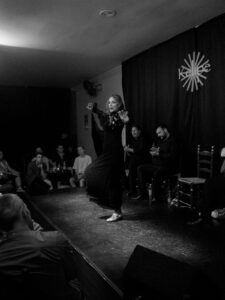
Flamenco does not happen in isolation. The dance listens to the singing, the guitar sets the direction, and the voice finds its place within the rhythm. Each discipline has its own language, but it is when they come together that Flamenco reveals its full meaning.
That is why learning Flamenco goes far beyond repeating steps, memorising lyrics or practising chords. It means learning to listen, recognising the beats, understanding how artists respond to one another and discovering how each element contributes to a shared musical dialogue.
At KELIPÉ Teatro & Centro de Arte Flamenco in Malaga, dance, singing and guitar classes are taught with this connection at their heart. In-person sessions feature live accompaniment from KELIPÉ’s exclusive artists, with no recorded music. After all, practising a movement is one thing; learning to perform it within the rhythm, listening to everything happening around you, is quite another.
Dance, singing and guitar: Three ways of understanding Flamenco
There are moments when a guitar signals what is about to come. The singing picks up that intention, and the dance responds through the body, hands and feet. There is no need for anyone to explain what is happening: the music speaks for itself.
Understanding this relationship is an essential part of learning. Dance needs to listen to the singing; the voice must find its place within the rhythm, and the guitar needs to know how to accompany both the singer and the dancer.
That is why classes at KELIPÉ are not simply about perfecting one discipline in isolation. Learning also involves recognising how the different expressions of Flamenco relate to one another and how each one influences the others.
Whether you are just starting out or already have experience, learning to listen changes the way you dance, sing or play.
Flamenco dance classes in Malaga: Finding the rhythm through movement
Flamenco dancing is about much more than learning a sequence of steps. It involves understanding the rhythm, controlling the body and discovering how to express music through movement.
At KELIPÉ’s Flamenco dance classes in Malaga, students practise with live guitar accompaniment. This approach allows them to learn by listening to real music, adapting their movements to what is happening and understanding how dance engages in a dialogue with the singing.
Footwork, arm movements, hand gestures, turns and body positioning are all part of the technical training. But technique truly comes to life when it stops being a sequence of movements and begins to respond to the music.
Classes are taught by Susana Manzano La Yedra and La Negri, experienced Flamenco professionals who guide students throughout their dance training.
Every step has its own timing. Every movement needs intention. And every body finds its own way of expressing itself within the rhythm.
Flamenco singing classes: Learning to listen is part of singing
The voice is one of Flamenco’s great protagonists, but singing is not simply a matter of performing lyrics or reproducing a melody. It also involves understanding the rhythm, recognising the beats and learning how to interact with the guitar and dance.
At KELIPÉ’s Flamenco singing classes, the guitar accompanies vocal practice, allowing students to explore the relationship between voice and music. The training helps them understand how singing develops within each musical structure and how it fits into Flamenco’s shared language.
Listening to the guitar, recognising musical entrances and understanding how singing can accompany or inspire dance are all essential parts of this process.
The voice is never alone. It draws on the music, plays with the timing and finds its expression within a tradition passed down through listening, practice and the sharing of knowledge.
Flamenco guitar Classes: Much more than playing chords
Flamenco guitar has a personality of its own. It establishes the rhythm, accompanies the singing, responds to the dance and creates the musical space in which each artist develops their expression.
Learning to play involves working on technique, rhythm, chords and the distinctive techniques of Flamenco guitar. But it also means understanding when to accompany, how to follow a singer and how to adapt to a dancer.
At KELIPÉ, Azukita, the centre’s exclusive guitarist and composer, teaches Flamenco guitar. The training focuses on understanding the instrument within the music, paying attention both to interpretation and to its role within the ensemble.
The relationship with singing and dance is fundamental. That is why, when the practice calls for it, these disciplines are also brought into the learning process. Guitar is not understood solely through the guitarist’s hands, but through everything happening musically around them.
KELIPÉ also offers online Flamenco guitar training for those who want to learn from elsewhere without needing to be in Malaga.
Why learning with live music makes a difference
Some things can be studied in a book or practised with a recording. But Flamenco has a musical dimension that can be discovered in a different way: by listening to artists and learning to respond to what happens in each moment.
KELIPÉ’s in-person classes do not use recorded music for accompaniment. Students work with the centre’s exclusive artists, allowing them to experience the relationship between dance, singing and guitar as part of the learning process itself.
Live music is not simply an extra feature of the class. It is an essential part of the teaching approach.
Dancers learn to listen to the guitarist and understand how the singing influences their interpretation. Singers discover how the guitar supports the voice and how dance fits into the rhythm. Guitarists learn that accompaniment also requires attention, sensitivity and the ability to respond.
In this way, each discipline retains its own identity without losing sight of the whole.
Learn Flamenco with KELIPÉ artists
KELIPÉ Teatro & Centro de Arte Flamenco has been dedicated to Flamenco in Malaga since 2001. Its artistic work also extends to teaching, where learning is connected to the practical experience and knowledge of those who work with this art form.
Dance and singing classes are taught by Susana Manzano La Yedra and La Negri, while Flamenco guitar classes are led by Azukita. Singing training completes this offering, bringing the different disciplines together to provide a broader understanding of Flamenco.
The aim is not simply to develop technical skills, but to learn to recognise the rhythm, listen to other artists and understand how music is created collectively.
Flamenco is also passed down in this way: by sharing knowledge, practising alongside other artists and learning to recognise what cannot always be explained in words.
Flamenco classes in Malaga and online Flamenco guitar training
If you want to learn Flamenco dance, singing or guitar, KELIPÉ offers training rooted in the real practice of this art form.
In-person classes take place in Malaga and include live accompaniment from the centre’s exclusive artists. For those who want to study guitar from elsewhere, online training is also available.
Whether you are taking your first steps or looking to deepen your knowledge of a discipline you already practise, learning begins with listening, develops through practice and becomes richer as you understand the relationship between music and movement.
Would you like more information about the classes?
Contact KELIPÉ to find out more about the available training options and choose the format that best suits your needs.
Telephone: +34 665 09 73 59
Email: kelipe.manzano@gmail.com
Email: kelipe@kelipe.net
Learning Flamenco means discovering a language built through dance, singing and guitar. At KELIPÉ, that learning begins by listening to the music from within.