

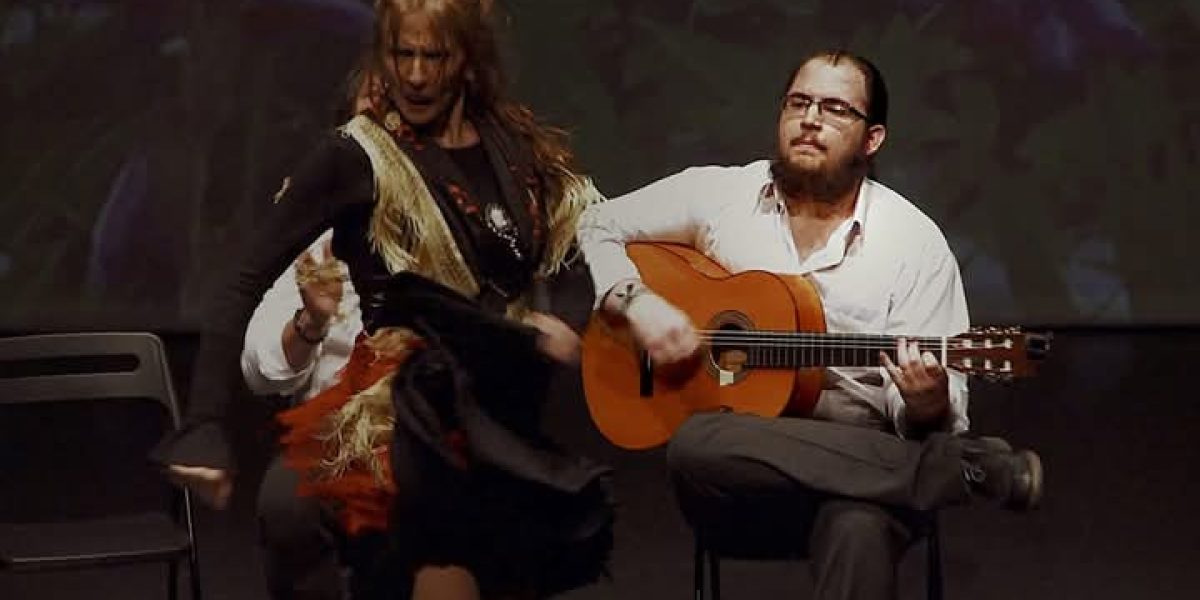
To speak about Flamenco is to speak about one of Andalusia’s most important cultural expressions. But it is also to speak about the people who helped preserve it, pass it on and develop it throughout generations.
Although Flamenco is the result of multiple cultural influences, the contribution of the Romani people has been fundamental to its development and to the way it understands art as a means of expressing life, emotions and collective experience.
That is why, when we talk about Flamenco and Romani culture, we are not speaking only about history. We are speaking about a cultural heritage that remains alive today and continues to move audiences all over the world.
An art form born from many paths
People often look for a single origin for Flamenco, but the reality is far richer and more complex.
Flamenco developed in Andalusia through the meeting of different cultures and traditions that coexisted in this land for centuries. Musical, social and human influences gradually shaped a unique artistic language that would eventually become one of Spain’s most recognisable cultural symbols.
Within this process, the Romani community played an essential role.
Not only because of its artistic contribution, but also because of the way it helped preserve, pass on and develop a distinctive understanding of singing, dance and music.
Flamenco before the stage
Today, we often associate Flamenco with theatres, festivals and professional performances.
However, for much of its history, Flamenco did not belong to the stage.
It lived in family homes.
In courtyards.
At family gatherings.
During celebrations.
In places where there was no intention of performing for an audience, but simply of sharing.
The singing emerged naturally.
The guitar accompanied it.
The dance appeared when someone felt the need to express themselves.
This oral and family-based tradition was crucial in ensuring Flamenco survived and reached the present day.
Many artists grew up listening to parents, grandparents, uncles, aunts and neighbours singing and playing music. They learned through observation, feeling and participation.
Before becoming a profession, Flamenco was a way of life.
Beyond technique
When someone sees Flamenco for the first time, they often focus on technique.
The speed of the footwork.
The complexity of the guitar playing.
The power of the voice.
But those who live alongside this art form know there is something more.
Flamenco also speaks of personality.
Of identity.
Of experience.
Of the unique way each artist expresses emotion.
That is why two people can perform the same Flamenco style and evoke completely different feelings.
And it is precisely here that one of the greatest contributions of Romani culture to Flamenco emerges: the importance of personal identity.
It is not about imitation.
It is about finding your own voice.
Your own language.
Your own unique way of expressing something that comes from within.
The importance of family transmission
One of the most valuable characteristics of Flamenco is that many of its lessons cannot be found in books.
They are found in everyday life.
In conversations.
In shared moments.
For generations, many Romani families passed on artistic knowledge naturally, weaving Flamenco into daily life.
It was not something that happened only during a performance.
It formed part of everyday existence.
That is why even today many artists speak of their elders as their greatest teachers.
People who taught them far more than technique.
They taught them a way of feeling and understanding art.
The dialogue that makes Flamenco unique
There is something that sets Flamenco apart from many other art forms.
The constant conversation between those taking part.
The guitar listens to the singing.
The singing responds to the dance.
The dance inspires the guitar.
Everything is connected.
Everything evolves.
And although similar pieces may be performed, they never happen in exactly the same way.
New nuances always emerge.
Small changes.
Details born in the moment.
That is why Flamenco has such a remarkable ability to remain alive.
Because it does not function as a mechanical reproduction.
It functions as a conversation.
An intimate conversation that can never be repeated in exactly the same way.
Culture, identity and memory
For many people, Flamenco has also been a way of preserving memory.
A way of passing on stories, emotions and experiences that could hardly be expressed in any other way.
Through song, people have shared joy, hardship, celebration and loss.
That is why Flamenco is not simply music or dance.
It is also a form of cultural communication.
A way of preserving collective identity while allowing each artist to contribute their own personality.
Perhaps that is why it continues to move people, even those who do not understand the language or have any prior knowledge of Flamenco.
Because genuine emotions are universal.
Flamenco remains alive because it is passed on
Flamenco has survived to the present day thanks to the people who have lived it, shared it and passed it on.
Generation after generation, artists, families and enthusiasts have kept alive a way of feeling and expressing life through singing, guitar and dance.
Each artist brings their own personality, experiences and understanding of art, yet the essence remains.
That is why Flamenco continues to move people.
More than an artistic expression, it is a cultural inheritance that continues to be passed from one pair of hands to another, from one voice to another and from one heart to another.
And perhaps that is where one of its greatest strengths lies: its ability to remain alive without losing its identity.
KELIPÉ and a love for a living culture
From the very beginning, KELIPÉ was founded on a clear idea: to create a space where Flamenco could be experienced through closeness, respect and a genuine love for this culture.
Founded by Susana La Yedra in 2001, KELIPÉ has spent more than two decades developing artistic and educational projects that have introduced Flamenco to thousands of people from around the world.
But beyond the performances, there is a philosophy.
An understanding of Flamenco as a living conversation.
As a meeting between artists.
As a cultural expression that does not require grand effects to move people.
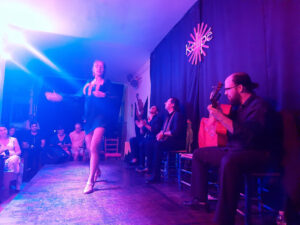
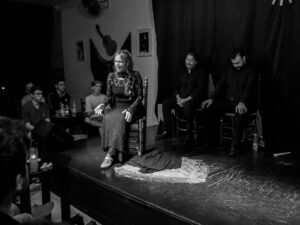
On stage, the guitar, singing and dance are in constant dialogue.
There is space for improvisation.
For nuance.
For emotions that emerge naturally in the moment.
Because Flamenco is not built solely upon technique.
It is also built upon experience, personality and human connection.
Experiencing Flamenco live
Understanding the relationship between Flamenco and Romani culture is one way of approaching this art form. Experiencing it live is something entirely different.
The energy of the guitar, the dialogue between singing and dance, the shared silences and the nuances that emerge during each performance reveal aspects of Flamenco that are difficult to explain with words alone.
If you would like to discover this tradition up close and enjoy a performance in the heart of Málaga, you can view upcoming dates and reserve your tickets at KELIPÉ.
Click here to book your live Flamenco tickets at KELIPÉ.
A heritage that continues
Today, Flamenco forms part of Andalusia’s cultural heritage and is admired throughout the world.
Yet its strength still comes from something very simple.
People who love this art.
People who share it.
People who continue to pass it on.
That is why speaking about Flamenco and Romani culture is not simply about looking to the past.
It is about recognising a heritage that remains present.
A heritage that continues to inspire new generations of artists and audiences alike.
And that reminds us that Flamenco, before it is a performance, is a way of feeling, sharing and living culture.