

Who decided to take the first step? When did the first Flamenco footwork appear? At what point did body movement begin to develop into the language we now recognise as Flamenco dance?
There is no single date that provides the answer.
Flamenco did not emerge overnight, nor does it have a single birthplace. Its history gradually took shape in Andalusia, through the meeting of different forms of music, singing and expression that came together to create a unique way of understanding art.
And within this language, dance holds a very special place.
Because Flamenco also tells its story through the body.
Through feet marking the rhythm. Hands accompanying the music. Arms tracing movements through the air. A glance. A pause.
That is why learning about the history of Flamenco dance is not simply about discovering when it first appeared or where it was performed. It is about understanding how a living language has developed and continues to evolve every time someone dances.
Where does the history of Flamenco dance begin?
There is no single date we can point to as the birth of Flamenco dance.
And perhaps that is one of the keys to understanding it.
Flamenco gradually took shape in Andalusia over time, within a setting where different musical and cultural traditions coexisted. Rather than emerging as a finished creation, it developed into an artistic expression with its own distinctive codes and ways of performing.
Dance emerged alongside music and Flamenco singing.
There was no one person inventing steps in front of a mirror and then teaching them to others. Flamenco was learned by living it, listening to it, watching it and sharing it.
This is where an essential part of its identity comes from: Flamenco is learned from others, but it also becomes your own.
Andalusia: where Flamenco found its language
To understand Flamenco dance, we need to look towards Andalusia.
Cadiz, Jerez, Seville, Granada, Cordoba and Malaga are all part of a region deeply connected to the history of Flamenco. Each area developed its own ways of experiencing and expressing this art form.
Music, singing and dance were present in different aspects of everyday life and gradually developed increasingly recognisable patterns and structures.
Rhythm became a fundamental reference point.
The body began to respond to that rhythm with ever greater precision.
And dance developed the elements we now immediately associate with Flamenco: intricate footwork, arm movements, expressive hands, posture, attitude and that constant relationship between the dancer and the music.
But one thing is important to remember:
Dance was never alone.
There has always been a dialogue with Flamenco singing and guitar.
Before the big stages: learning by watching
For a long time, Flamenco was not learned in the way we think of a dance class today.
It was learned by watching.
Listening.
Repeating.
Sharing.
Knowledge passed from one person to another and, in many cases, from generation to generation within families and communities connected to Flamenco.
A child might grow up listening to singing, watching people dance and learning to recognise a rhythm long before receiving a formal explanation of what they were hearing.
That is why oral and practical transmission has played such an important role in the history of Flamenco.
Not everything could be explained in words.
It had to be seen.
It had to be heard.
And, above all, it had to be felt in the body.
Gypsy dance and the roots of Flamenco
To understand the history of Flamenco dance, it is essential to recognise the contribution of the Gypsy people to the development of this art form.
In Andalusia, Gypsy communities played a vital role in passing down and developing many of its forms of artistic expression.
Flamenco also emerged in everyday settings, at family gatherings and social occasions where, after a meal, singing, clapping and dancing were part of a shared way of life.
In these moments, singing and dance were passed down naturally, as people watched older generations, listened and learned from those who had inherited this knowledge before them.
The body, the hands, the rhythm and the way of performing held a significance that went far beyond technique. They were part of a cultural memory passed down from generation to generation.
Over time, Flamenco dance developed a stronger stage presence.
Footwork technique, body control, choreography and professional training became increasingly prominent as Flamenco made its way into dance academies, cafés cantantes and theatres.
However, behind this technical training remains a deep-rooted connection to Andalusia’s Gypsy communities and their ways of living, feeling and passing on their art.
Gypsy Flamenco cannot be understood simply as a style of dance, but also as a cultural heritage that has played a decisive role in shaping Flamenco’s identity.
Recognising these roots means acknowledging the families and generations who preserved, performed and passed down an essential part of this artistic language.
When Flamenco reached the stage
Flamenco also moved into new spaces.
From informal gatherings and celebrations, it made its way into venues where audiences could watch it as a performance. Cafés cantantes — cafés featuring live singing and music — played a fundamental role in this process, bringing artists, musicians, Flamenco singers and dancers together on stage before an audience.
And something interesting happened.
Dance began to develop an increasingly theatrical dimension.
Technique became more important. Artists developed their own distinctive ways of performing. Movements became more elaborate, and dance began to establish its own place within the show.
Later came theatres and other major stages.
But one thing never disappeared:
the dialogue between dance, singing and guitar.
Because the stage can change.
The size of the venue can change.
But when that dialogue disappears, an essential part of Flamenco’s language disappears with it.
Why is the body so important in Flamenco dance?
Because in Flamenco, the body speaks.
The feet can mark the rhythm with extraordinary precision. The arms support and extend the movement. The hands can become a form of expression in their own right.
And then there is the attitude.
The gaze.
The pause.
The way the dancer occupies the space.
The same sequence can convey something completely different depending on who performs it.
That is why two people can dance the same Flamenco style and offer entirely different interpretations.
Technique matters, of course.
But technique is only one part of it.
Flamenco dance also requires personality, attentive listening and the ability to respond to what is happening in the music.
Rhythm: when dancing also means listening
There is one word that comes up time and again when we talk about Flamenco: rhythm.
And that is no coincidence.
Rhythm is one of the foundations of Flamenco and allows dance, guitar, singing and hand clapping to come together around a shared musical structure.
The dancer is not simply following music playing in the background.
They are part of it.
Listening to the guitar. Responding to the singing. Feeling the hand clapping. Marking the rhythm. Answering the music.
And at certain moments, even a pause can carry as much power as a movement.
That is why learning Flamenco dance means learning to listen before trying to move faster.
First, the rhythm.
Then, the body.
Bulerias, solea, alegrías… why are Flamenco dances so different?
Because Flamenco is not a single dance.
It is a whole world of styles, traditionally known as palos, each with its own personality.
Alegrías have a lively, bright character. Bulerías play with rhythm and the interaction between performers. Soleá has a distinctive depth. Tangos have a different rhythmic feel and expressive character.
And these differences completely change the way the dance is performed.
The body has to adapt to the music.
Movement has to respond to the rhythm.
And the artist needs to understand what each style calls for.
That is why learning Flamenco is not simply about collecting steps. The more you discover about this art form, the more you realise that every movement is built around a musical structure.
The great names of Flamenco dance
The history of Flamenco dance also has its own leading figures.
Artists from different generations have devoted their lives to this art form, leaving a lasting mark on the way it is danced and performed on stage.
They have brought Flamenco to theatres, festivals and stages around the world, demonstrating that an art form born and developed in Andalusia can connect with very different audiences without losing its identity.
But behind every great performer lies something less visible:
years of work.
Hours of rehearsal.
Discipline.
Listening.
And a lifetime dedicated to learning.
So when we watch an outstanding Flamenco dancer on stage, we are seeing the result of a journey far longer than the few minutes their performance lasts.
What does Malaga have to do with the history of Flamenco dance?
A great deal.
Malaga is part of Andalusia’s Flamenco landscape and has its own traditions connected to singing, dance and guitar.
The city has long been, and continues to be, a meeting place for artists and Flamenco enthusiasts.
Today, this connection can be explored in many ways: from watching a live performance to taking a class or joining a workshop where the audience stops watching and starts participating.
Because watching someone dance is one thing.
Trying to follow a rhythm with your own feet and suddenly discovering that it is not as easy as it looks is something else entirely.
Learning Flamenco dance: when the audience becomes the student
Perhaps one of the best ways to understand Flamenco dance is to try learning it.
Anyone who starts their first classes quickly discovers that a few seconds of dancing can be the result of years of learning. You need to work on posture, arms, hands, feet and, of course, rhythm.
But you also need to learn how to listen.
At KELIPÉ, teaching forms part of this ongoing transmission of Flamenco. Susana Manzano La Yedra and La Negri share their knowledge and experience of teaching Flamenco dance, while Azukita, KELIPÉ’s exclusive guitarist, teaches Flamenco guitar.
Each discipline requires a different learning process, but they are all connected by the same foundation: discovering the language of Flamenco through practice, understanding its rhythm and learning how to engage with the other elements that make up this art form.
Because teaching is also a way of keeping knowledge alive.
Susana Manzano La Yedra and Azukita: two ways of passing on Flamenco
At KELIPÉ, the transmission of Flamenco is also deeply connected to its artists.
Susana Manzano La Yedra, founder of KELIPÉ, is a Flamenco dancer and teacher. Coming from prominent Roma families with deep ties to Flamenco, her dancing is closely connected to an artistic memory passed down through generations.
Her hands do more than accompany the music.
They speak.
They carry gestures, movements and ways of feeling Flamenco that have travelled from one generation to the next, like a living memory that remains in the body of the dancer.
Azukita, KELIPÉ’s exclusive guitarist, also plays an important role as a musician, composer and Flamenco guitar teacher. His teaching allows students to explore the guitar through technical and musical knowledge, while also understanding its relationship with dance and singing.
One of Azukita’s aims during lessons is to give students the resources and tools they can continue using after the course has finished. It is not just about learning during lessons, but about gaining the knowledge needed to practise independently, explore the music in greater depth and continue developing their skills.
Alongside them, La Negri also teaches Flamenco dance at KELIPÉ, sharing her experience and knowledge with those who want to learn and deepen their understanding of this art form.
Dance and guitar offer two different learning paths, but they are part of the same language.
And at KELIPÉ, they come together.
Flamenco dance at KELIPÉ
At KELIPÉ Teatro & Centro de Arte Flamenco, dance is not understood simply as one part of a performance.
It is part of a wider way of living, teaching and passing on Flamenco.
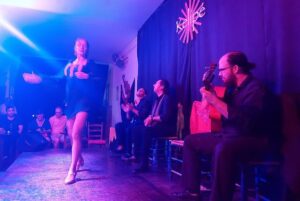
On stage, dance shares the spotlight with singing and guitar in a fully live performance. Away from the stage, teaching allows those who want to discover this art form to experience it through practice.
It is a way of keeping two fundamental aspects of Flamenco connected: performance and transmission.
Because Flamenco is not preserved simply by remembering its history.
It is also kept alive whenever it is danced, played, sung and taught.
Flamenco dance does not belong only to the past
Perhaps this is the best way to bring our journey through its history to a close.
Flamenco dance belongs to a tradition with a deep history, but it is not a museum piece.
It lives on whenever an artist steps onto a wooden Flamenco stage.
When a guitar begins to play.
When a Flamenco singer joins the rhythm.
When someone learns their first steps.
When a teacher passes on a movement they once learned from someone else.
The history of Flamenco dance lives precisely in everything that has been passed down, learned and continues to be performed.
Because every time someone dances Flamenco, its history unfolds all over again on stage.