


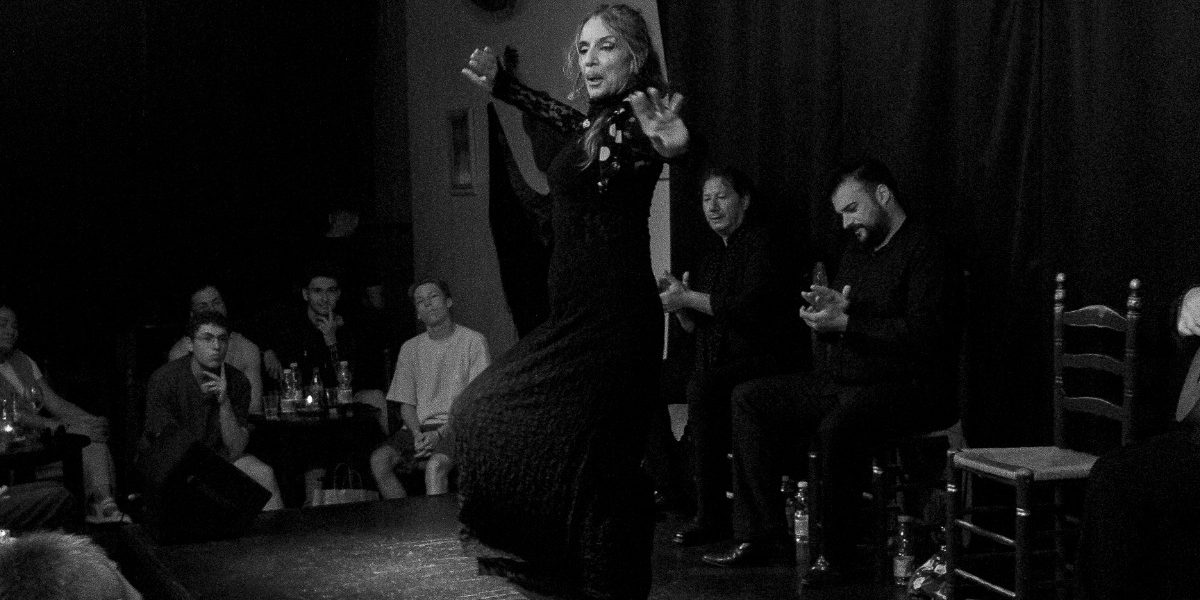
When someone searches for what to see at a Flamenco show in Malaga, they will usually find many different options. But before choosing where to experience it, it is worth understanding what really happens on a Flamenco stage.
Flamenco is not simply dance. Nor is it just music. A performance brings together different forms of expression that are constantly connected: dance, singing, guitar, handclaps and rhythm.
Each element has its own language, but none of them works entirely in isolation.
The guitar can respond to a movement in the dance. The Flamenco singer can change the way they interpret a passage depending on what is happening on stage. The dancer can listen to the singing and guitar to shape their interpretation. And rhythm holds this entire dialogue together.
That is why attending a live Flamenco performance allows you to discover much more than a succession of songs or choreographies.
Flamenco dance: Much more than choreography
Dance is probably one of the elements that attracts the most attention when someone watches a Flamenco performance for the first time.
The movements of the arms, hands and body, the turns and, especially, the footwork are all part of an artistic language that requires technique, knowledge and many years of preparation.
But Flamenco dance is not simply about performing learned movements.
Interpretation plays a fundamental role.
A Flamenco dancer can use their body to express strength, emotion, tension, joy or depth. The way they move their hands, use their arms or mark the rhythm with their feet forms part of their personal way of interpreting Flamenco.
At KELIPÉ, the dancing of Susana Manzano La Yedra, founder of the Teatro & Centro de Arte Flamenco, is an essential part of the venue’s artistic identity.
Her hands, movements and way of interpreting form part of an artistic memory connected to her career and to the generations of artists from whom she comes.
That is why, when watching Flamenco dance live, it is worth looking beyond the most obvious movements.
Body expression, the gaze, the hands, the relationship with the music and the way the rhythm is marked are all part of what is happening on stage.
Flamenco guitar: Much more than accompaniment
Flamenco guitar has an essential role within a performance.
It accompanies the dance and singing, but it can also develop its own musical voice.
The technique of Flamenco guitar combines rhythm, harmony, melody and different techniques specific to the instrument. But above all, there is a constant relationship with what is happening on stage.
At KELIPÉ, this dimension is particularly connected to Azukita, exclusive guitarist and composer.
His work as a musician goes beyond accompaniment. His original compositions form part of KELIPÉ’s repertoire and give the performances their own distinctive musical identity.
During a performance, the guitar can accompany a sequence of dance, respond to the singing or take centre stage at particular moments.
That is why, when watching a Flamenco performance, it is also worth listening to the guitar as another voice within the performance.
Flamenco singing: The voice that expresses and accompanies
Singing is another of the fundamental pillars of Flamenco.
The Flamenco singer’s voice does not simply provide musical accompaniment. Singing has its own language, different forms of expression and a constant relationship with the other artists.
The singer can set a particular direction and establish a dialogue with the guitar or dance.
In a live performance, that relationship can also change from one moment to the next.
Antonio Cortés, KELIPÉ’s exclusive Flamenco singer, brings a voice connected to Andalusia and to his roots in Malaga and Granada. His interpretation forms part of the dialogue between singing, guitar and dance.
For anyone discovering Flamenco, listening carefully to the singing reveals something important: the voice is not simply following pre-recorded music.
It is part of what is happening in that very moment.
Flamenco rhythm: The element that brings everything together
There is one word that constantly appears when talking about Flamenco: rhythm.
Fully understanding it takes time and knowledge, but even someone approaching Flamenco for the first time can begin to appreciate its importance.
Flamenco rhythm is a rhythmic structure that allows the different elements of Flamenco to connect with one another.
Dance, guitar, singing and handclaps all find common ground within it.
Rhythm allows an artist to know where they are within the music and how they can interact with the others. It is also one of the reasons why Flamenco can create such a distinctive sense of movement and tension, even when seemingly very little is happening on stage.
It is not simply about keeping time.
It is about understanding it.
When dance, dinging and guitar come together
One of the most interesting things to observe during a live Flamenco performance is precisely the relationship between the artists.
They are not three independent elements appearing one after another.
The dance listens to the guitar.
The guitar listens to the singing.
The singing responds to the dance.
And all of them are connected by rhythm.
This dialogue is particularly important in a performance that takes place entirely live.
Each artist must remain attentive to what is happening in that moment. A look, a movement, a pause or a change in intensity can prompt a response from another artist.
This is where Flamenco takes on a dimension that is difficult to explain through a recording alone.
The audience is not simply watching a performance.
They are witnessing an artistic encounter that is happening in that very moment.
The value of experiencing Flamenco live
Seeing Flamenco live allows you to notice details that can easily go unnoticed when you only know the art form through videos or recordings.
The sound of the guitar.
The sound of the dancers’ feet striking the wooden stage.
The Flamenco singer’s voice.
The handclaps.
The artists’ breathing.
The pauses.
The audience’s reaction.
Everything forms part of the experience.
That is why, when searching for what to see at a Flamenco show in Malaga, it is worth considering more than just the venue or the duration.
It is also interesting to understand how the artistic performance unfolds and who the artists on stage are.
What does it mean to experience authentic Flamenco?
Authentic Flamenco comes from knowledge, dedication and a deep relationship with this art form.
Behind every performance there is learning, years of work and a way of understanding Flamenco that is passed down from one generation to the next.
Authenticity is also found in the way the art is interpreted. In understanding the singing, guitar, dance and rhythm. In recognising that each of these elements forms part of the same language and that, when they come together on stage, they create a dialogue that can only happen live.
At KELIPÉ, understanding Flamenco through authenticity means passing it on, preserving it, interpreting it and continuing a living tradition.
A tradition that cannot be understood solely through what happens on stage, but also through those who have learned it, lived it and continue to dedicate their lives to this art.
That is why experiencing authentic Flamenco is about feeling that there is something real behind every performance: artists, knowledge, experience, dedication and respect for Flamenco.
And it is precisely this connection that allows audiences to approach the art not only as spectators, but through the emotion of experiencing it live.
KELIPÉ: Flamenco Theatre, arts centre and venue in Malaga
In the historic centre of Malaga, you will find KELIPÉ Teatro & Centro de Arte Flamenco, a space dedicated to Flamenco since 2001.
KELIPÉ is a Flamenco theatre and arts centre, and also has its own wooden Flamenco stage. This combination is part of its identity and reflects an approach to Flamenco that goes beyond simply presenting a performance.
Performances last approximately 90 minutes and take place entirely live.
KELIPÉ also follows a very specific philosophy: offering one performance per day.
This gives each show its own space and focus, allowing the artists to devote all their energy to that encounter with the audience.
The artistic programme features exclusive artists such as Susana Manzano La Yedra, Azukita and Antonio Cortés, each bringing their own artistic language.
The result is a performance where dance, guitar and singing come together on the same stage.
When the artists make every performance different
Everything that happens on stage takes on a different dimension when it happens live.
At KELIPÉ, dance, guitar and singing do not develop as independent elements. The artists listen to one another, watch one another and react to each other throughout the performance.
The same sequence can take on different nuances depending on the moment, the interpretation and the connection established between the artists.
It is precisely this communication that means a performance is not simply a reproduction of something that has already been established.
The experience lies in the encounter.
In the way a guitar can accompany a dancer’s movement. In the way the singing can intensify a moment in the dance. In the way rhythm allows everyone to find the same point of connection.
That is why, when watching a live Flamenco performance, it is worth observing the relationship between the artists as well.
Not only what each person does.
But how they listen to one another.
A Flamenco experience in the heart of Malaga
If you are searching for what to see at a Flamenco show in Malaga, understanding these elements can help you experience the performance in a different way.
Perhaps the first time you hear a Flamenco guitar, you will not recognise all of its techniques.
Perhaps you will not know the different Flamenco styles.
Perhaps you will not be able to identify every rhythmic structure.
You do not need to.
You can simply observe.
Listen to how the guitar changes when the dance begins. Notice the dancer’s hands. Listen to the Flamenco singer’s voice. Hear the sound of the feet striking the wooden stage. Feel how the rhythm connects everything that is happening.
Over time, each detail can begin to take on a different meaning.
And that is one of the most fascinating ways of approaching Flamenco: discovering an artistic language that can be enjoyed from the very first moment while also offering a depth that can never be completely exhausted.
Which Flamenco show should you see in Malaga?
Malaga offers different possibilities for those who want to discover Flamenco.
The right choice will depend on what each person is looking for: the venue, the artists, the type of performance, its duration or its location.
If you are looking for an experience centred on authentic live Flamenco, KELIPÉ offers approximately 90-minute performances at its Teatro & Centro de Arte Flamenco and wooden Flamenco stage in the historic centre of Malaga.
Tickets are available from €28.
You can check availability and book your Flamenco experience through Flamenco Tickets – KELIPÉ.


